Businesses spend thousands on ads, tools, and hiring then wonder why customers don’t stick around. The answer, more often than not, isn’t the product. It’s the brand.
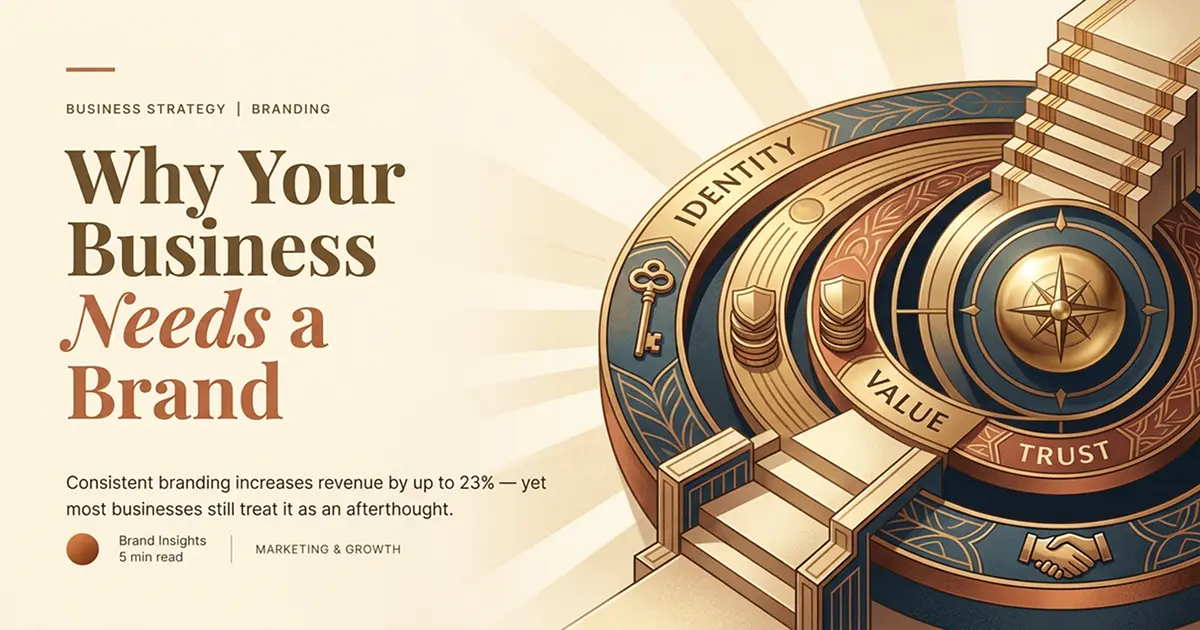
Studies show that consistent branding across all channels increases revenue by up to 23%. Yet most small and mid-sized businesses treat branding as decoration, a logo you commission once and forget. That’s a costly mistake.
If you’re building a business that wants to grow, retain customers, and command premium pricing, branding isn’t optional. Here’s why.
What Branding Actually Means (It’s Not Just a Logo)
Let’s clear this up first. Branding is not your logo. It’s not your color palette or your Instagram aesthetic.
Your brand is the sum total of every impression your business makes how your website reads, how your emails sound, how your team answers the phone, what customers say about you when you’re not in the room. Your logo is a symbol of that brand. The brand itself is the reputation, the feeling, the promise.
When Apple shows you a product, you know immediately what to expect: clean, premium, intuitive. That consistency didn’t happen by accident. It was built through deliberate, sustained branding across every touchpoint. That’s the standard worth aiming for no matter your industry or budget.
Branding Builds Trust Before the First Sale
Here’s the hard truth: customers don’t trust new businesses. They have no reason to. Scams exist, products disappoint, and attention is expensive.
A strong brand signals credibility. A polished website, a clear brand voice, consistent visuals, and a coherent story all tell the customer: we’re serious, we know what we’re doing, and we’ll deliver. Weak or inconsistent branding does the opposite; it introduces doubt.
Consider two local accountants. One has a generic name, a clip-art logo, and a website that looks like it was built in 2009. The other has a clean identity, a defined niche, and a clear message: “We help creative freelancers stop dreading tax season.” Which one gets hired? Almost always the second even if their actual skills are identical. Branding does the trust-building before the conversation even starts.
A Strong Brand Justifies Higher Prices
Branding is the direct line between your business and your pricing power.
Generic products compete on price. Branded products compete on value. A white-label coffee brand and a carefully crafted specialty roaster might use similar beans but one sells for $8 a bag and the other for $22. The difference isn’t the coffee. It’s the story, the identity, the experience around it.
This isn’t reserved for consumer goods. A B2B consultancy with a sharp, distinctive brand can charge 2–3x more than a competitor with equivalent expertise but no recognizable identity. Clients aren’t just paying for deliverables they’re paying for confidence. Branding manufactures that confidence at scale.
If you’ve ever felt pressure to discount, the first question to ask isn’t “is my price too high?” It’s “is my brand strong enough to justify my price?”
Branding Attracts the Right Customers (and Repels the Wrong Ones)
Not all revenue is good revenue. A poorly defined brand pulls in everyone which often means attracting clients who undervalue you, drain your team, and churn fast.
A specific, well-positioned brand acts as a filter. When your messaging is clear about who you serve and what you stand for, ideal customers self-select in and misaligned ones move on. This reduces wasted sales effort, increases retention, and builds a customer base that actually refers you.
Think of your brand as a long-form job ad for customers. The more specific and authentic it is, the better the candidates it attracts. Vague brands attract vague commitment. Sharp brands attract loyal advocates.
Branding Makes Every Other Marketing Investment Work Harder
Every ad you run, every post you publish, every email you send all of it is more effective when it ladders up to a coherent brand.
Without branding, marketing is a series of disconnected messages fighting for attention. With branding, each touchpoint reinforces the last. Customers start to recognize you, associate your name with quality, and remember you when the buying decision arrives.
Recognition requires repetition. According to the “Rule of Seven,” a prospect needs to encounter your brand at least seven times before taking action. If each encounter looks and feels different, those seven touchpoints count for almost nothing. If they’re consistent same voice, same values, same visual identity they compound into trust and recall.
This is why businesses with strong brands get better ROI on paid ads, higher email open rates, and more inbound leads. The brand is doing the heavy lifting before the marketing even begins.
Branding Retains Employees, Not Just Customers
This one surprises people: branding is an internal asset as much as an external one.
Top talent wants to work for brands they believe in. A company with a clear mission, strong values, and a reputation worth being part of attracts better candidates and keeps them longer. That’s not idealism it’s economics. Replacing an employee costs an average of 50–200% of their annual salary . Retention is one of the highest-ROI investments a business can make.
A strong employer brand also shapes culture. When employees understand what the company stands for and feel proud to represent it, they make better decisions, deliver more consistent customer experiences, and advocate for the business organically.
Start Building Your Brand Now, Not Later
There’s a common misconception that branding is something you do once the business is “big enough.” The truth is the opposite: branding is what makes a business big enough.
You don’t need an enormous budget to start. You need clarity on who you serve, what you stand for, and what makes you different. From there, every visual, every word, and every customer interaction becomes an opportunity to reinforce that identity.
The businesses winning in competitive markets aren’t always the ones with the best product. They’re the ones with the strongest, most consistent brand. Start there.
Ready to define your brand identity? or reach out to explore how a professional brand can transform your business growth.